CAD/CAM

CAD/CAM
Product, Tool, Machine, and Process Data
CAD/CAM systems form the foundation of modern industrial product development and manufacturing. CAD enables the computer-aided design of components, creating digital 3D models that include dimensions, tolerances, and material properties; the CAD model serves as the central digital description of the workpiece throughout its entire lifecycle. Based on this design data, the CAM system defines machining strategies, tool paths, and technological parameters, while also simulating tool movements and checking for collisions. This allows manufacturing processes to be geometrically analyzed prior to actual machining (collision checking, material removal simulation, machine simulation, etc.); finally, the CAM system uses a post-processor to generate the NC programs for the machine tools.
CAD/CAM
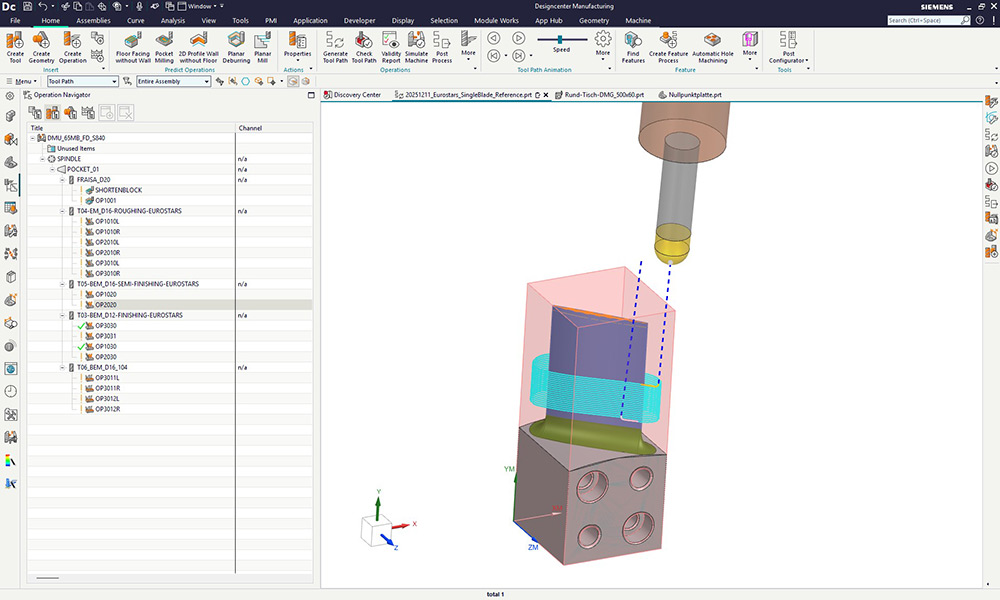
Practical example: compressor blade
Fraunhofer IPT possesses extensive expertise in CAD/CAM-based planning and programming for the manufacture of complex engine components. These include, among others, axial compressor blisks, radial compressor impellers, turbine disks, and other safety-critical parts. Using modern CAD/CAM systems, high-precision NC programs for multi-axis CNC machining are created, simulated, and optimized with regard to machining strategy, collision avoidance, and process reliability. In doing so, Fraunhofer IPT establishes the foundation for the efficient, cost-effective, and high-quality production of sophisticated aerospace components.
CAD/CAM
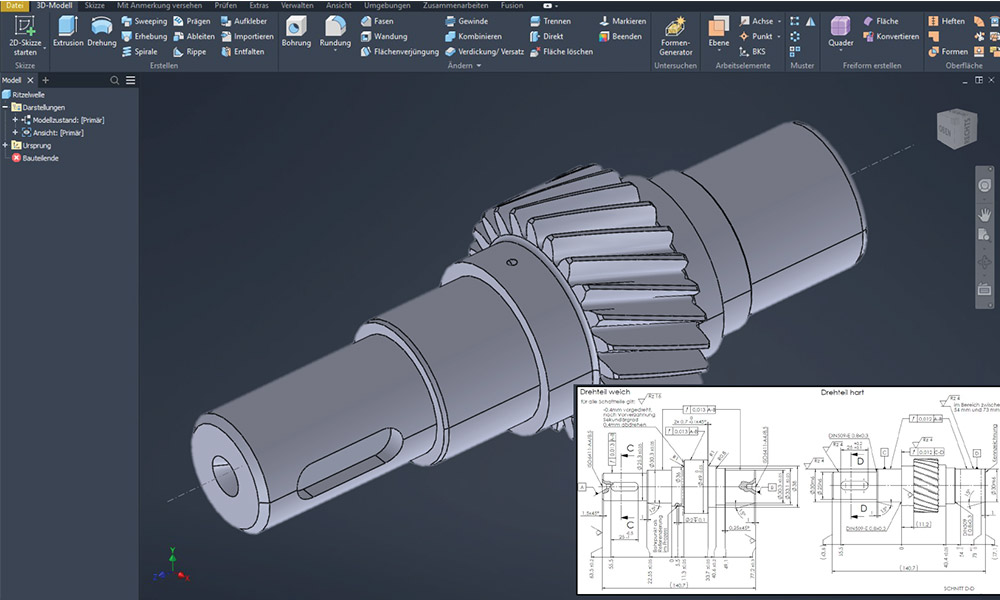
Practical example: Pinion shaft
MTI possesses extensive experience in the CAD-based definition and preparation of components for manufacturing. The use case in question focuses on the pinion shaft—a central component of an electric vehicle transmission within the powertrain. Modern CAD systems are used to generate and precisely document geometric specifications in the form of a 3D component model. These specifications encompass features such as gear teeth, bearing and fit seats, transition radii, and other characteristics relevant to function and manufacturing. In addition, product-specific manufacturing information (PMI)—including material data, surface requirements, and version status—is systematically integrated. The CAD model thus establishes the digital foundation for downstream stages such as process planning, manufacturing, inspection, and quality-driven traceability along the digital manufacturing process chain.